The Future of Bitcoin Mining 2026–2027: Trends and Predictions
The future of Bitcoin mining in 2026–2027 is seen from the consolidated perspective 2 years after the 2024 halving. The reduction of rewards to 3.125 BTC per block has completely reshaped the mining landscape, accelerating sector consolidation and the adoption of renewable energy. The current global mining matrix reflects the predictions from the previous cycle: efficient operators have survived and thrived, while inefficient ones have been eliminated.
This predictive analysis examines emerging trends, hashrate projections, technological evolution, and probable scenarios for the mining ecosystem in 2026–2027.
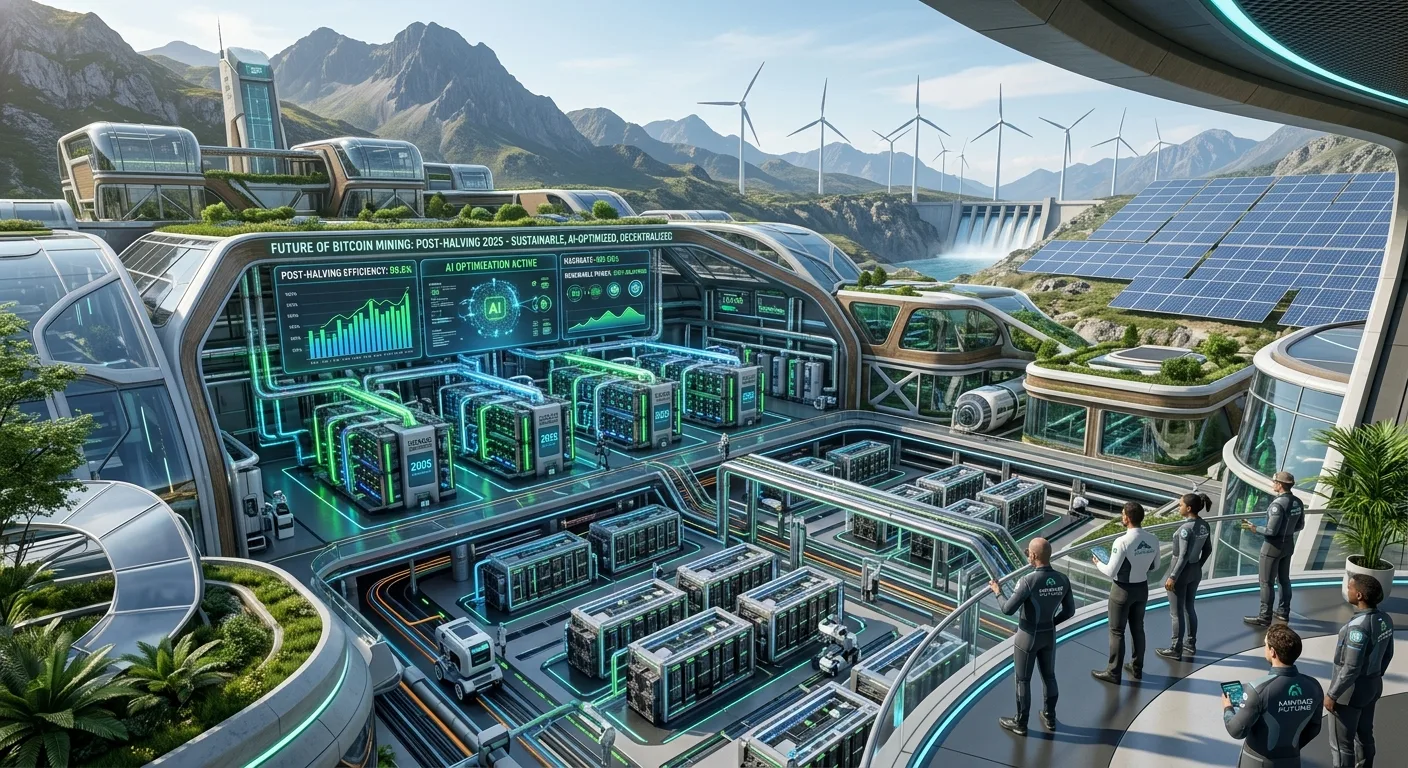
Context: 2 Years After the 2024 Halving
The April 2024 halving reduced mining rewards from 6.25 to 3.125 BTC per block, triggering massive sector consolidation. Two years after the event, we can see how predictions materialized and what the mining sector can expect in the 2026–2027 cycle:
| Halving | Date | Pre-Halving Price | Post-Price (12m) | Hashrate Change |
|---|---|---|---|---|
| 1st | Nov 2012 | $12 | $1,100 | +200% |
| 2nd | Jul 2016 | $650 | $2,500 | +150% |
| 3rd | May 2020 | $8,700 | $55,000 | +80% |
| 4th | Apr 2024 | $67,000 | $95,000 | +35% |
Immediate Impact Observed
- Shutdown of inefficient equipment: S19s and older progressively disconnecting
- Consolidation: Acquisitions from large operators to smaller ones
- Geographic migration: Search for cheaper energy
- Accelerated innovation: Pressure for greater efficiency
Defining Trends for 2026–2027
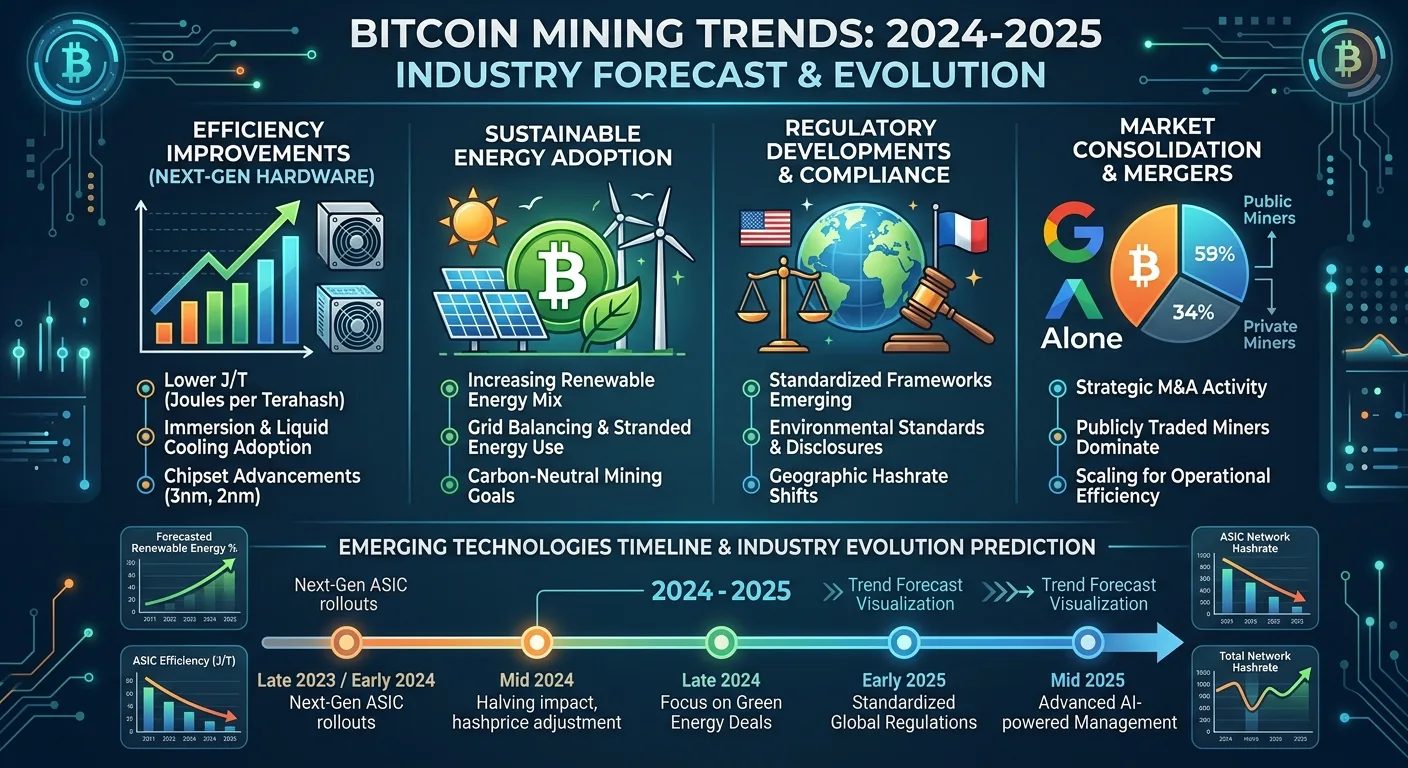
Trend 1: Market Consolidation
The number of independent mining operators will decrease dramatically:
| Metric | 2025 (Actual) | 2026–2027 (Projection) |
|---|---|---|
| Operators >100 MW | 55 | 75 (+36%) |
| Operators 10–100 MW | 160 | 140 (-12%) |
| Operators <10 MW | 1,500 | 900 (-40%) |
Drivers: Economies of scale in equipment purchases, preferential energy access, ability to sustain temporary losses.
Trend 2: Energy Hyper-Specialization
Successful miners will be those with access to differentiated energy sources:
| Source | 2026–2027 Advantage | Projected Share |
|---|---|---|
| Hydroelectric surpluses | <$0.025/kWh | 28% |
| Solar + Storage | $0.02–0.035/kWh | 32% |
| Offshore wind | $0.035–0.055/kWh | 16% |
| Residual/flare gas | Negative cost | 12% |
| Small modular nuclear | Clean base load | 7% |
| Traditional grid | >$0.08/kWh | 5% (declining) |
Trend 3: Sub-15 J/TH ASICs
The next generation of equipment will redefine efficiency:
| Generation | Efficiency | Estimated Year |
|---|---|---|
| Current (S22/M70) | 15–17 J/TH | 2026 |
| Next (S23/M80) | 13–15 J/TH | 2027 |
| Future (2nm) | 10–12 J/TH | 2028–2029 |
| Theoretical limit | ~8 J/TH | >2030 |
Equipment above 25 J/TH will be economically unviable for most operations.
Trend 4: Institutionalization and ETFs
Bitcoin spot ETFs have created institutional demand extending to mining:
- Miners in indices: Riot, Marathon, CleanSpark in Bloomberg ETFs
- Corporate acquisitions: Tesla, Block (Square) exploring mining
- Sophisticated financing: Convertible debt, equity raises, SPACs
- ESG compliance: Pressure for certified renewable energy
Global Hashrate Projections 2026–2027
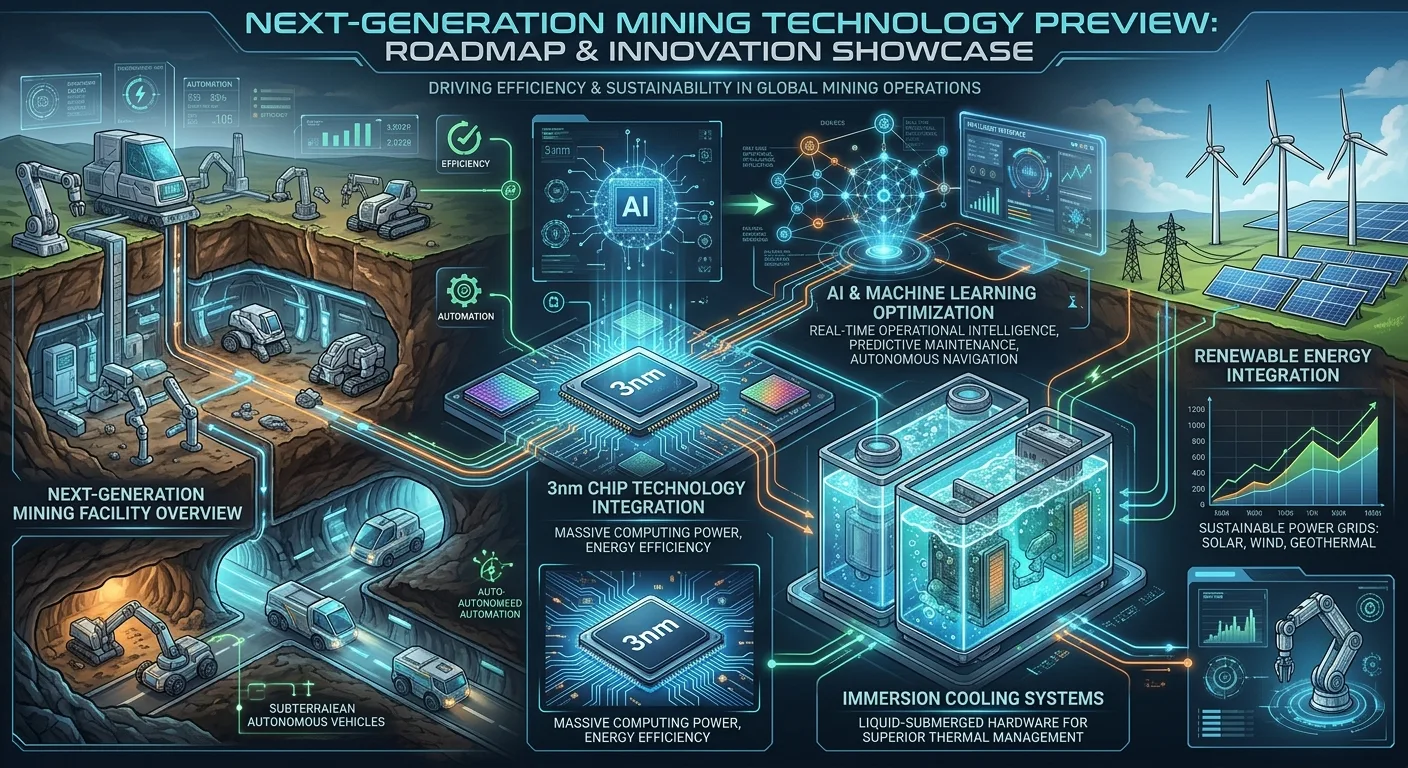
Hashrate Growth Scenarios
| Scenario | December 2025 | December 2026 | December 2027 | CAGR |
|---|---|---|---|---|
| Optimistic | 800 EH/s | 950 EH/s | 1,100 EH/s | +20% |
| Base | 720 EH/s | 850 EH/s | 980 EH/s | +18% |
| Pessimistic | 650 EH/s | 750 EH/s | 850 EH/s | +15% |
Projected Geographic Distribution 2026–2027
| Region | Hashrate 2025 | Hashrate 2027 | Change |
|---|---|---|---|
| United States | 35% | 30% | -5% (regulation) |
| Asia (ex-China) | 20% | 23% | +3% (Kazakhstan, etc.) |
| Europe | 11% | 10% | -1% |
| Latin America | 10% | 14% | +4% (expansion) |
| Africa | 4% | 6% | +2% (new entry) |
| Others | 20% | 17% | -3% |
Emerging Technologies
Immersion Cooling
| Aspect | 2025 Status | 2026–2027 Projection |
|---|---|---|
| Adoption | 15% of hashrate | 25% of hashrate |
| Efficiency benefit | +20–30% hashrate | +25–40% hashrate |
| Extended lifespan | +40% | +50% |
| Additional cost | +35% capex | +25% capex (at scale) |
Mining-as-a-Service (MaaS)
Emerging business models:
- Hashrate tokens: Tokenized representation of mining power
- Institutional cloud mining: 1–3 year hashrate contracts
- Mining DeFi: Liquidity pools backed by hardware
- Fractional ownership: Shared ownership of mining farms
Artificial Intelligence in Mining
Applications under development:
| Application | Description | Impact |
|---|---|---|
| Energy optimization | ML for operation timing | -10% electricity cost |
| Predictive maintenance | Fault detection before failure | -30% downtime |
| Auto-tuning | Dynamic frequency/voltage adjustment | +5–10% efficiency |
| Market making | Optimal BTC sale algorithms | +3–5% revenue |
Scenarios for Mining Investors
Scenario A: Bitcoin at $150,000 (Bull Case)
| Indicator | 2026–2027 Value |
|---|---|
| Hashrate | 1,000+ EH/s |
| Difficulty | +80% vs 2025 |
| Profitability of efficient equipment | Excellent |
| Profitability of obsolete equipment | Temporarily viable |
| Consolidation | Moderate |
Recommended strategy: Accumulate hashrate now, expand aggressively, reinvest profits.
Scenario B: Bitcoin at $80,000–100,000 (Base Case)
| Indicator | 2026–2027 Value |
|---|---|
| Hashrate | 900–950 EH/s |
| Difficulty | +60% vs 2025 |
| Profitability of efficient equipment | Good |
| Profitability of obsolete equipment | Marginal |
| Consolidation | Significant |
Recommended strategy: Maintain positions, optimize efficiency, preserve capital for opportunities.
Scenario C: Bitcoin at $50,000–60,000 (Bear Case)
| Indicator | 2026–2027 Value |
|---|---|
| Hashrate | 750–800 EH/s (contraction) |
| Difficulty | Stable or -5% |
| Profitability of efficient equipment | Marginal |
| Profitability of obsolete equipment | Impossible |
| Consolidation | Massive |
Recommended strategy: Survive, acquire distressed equipment and operations, prepare for next cycle.
Implications for Chilean Miners
Opportunities
- Diversified energy matrix: Solar, wind, and hydro available
- Free trade zones: Competitive advantages for importing equipment
- Institutional stability: Favorable contrast with neighboring countries
- Emerging hub: Opportunity to become a regional leader
Challenges
- Competition with Paraguay: Lower hydroelectric rates
- Limited infrastructure: Lack of specialized data centers
- Specialized knowledge: Shortage of local mining engineers
- Financing: Limited access to venture capital
Chile Projection 2026–2027
| Metric | 2025 | 2027 |
|---|---|---|
| National hashrate | 5–7 EH/s | 10–15 EH/s |
| Installed capacity | 80 MW | 150–200 MW |
| Professional operators | 25 | 35–45 |
| Global participation | 0.7% | 1.2–1.5% |
Frequently Asked Questions about the Future
Will mining still be profitable in 2026–2027?
For operations with electricity costs <$0.08/kWh and equipment <18 J/TH, yes. Two years after the 2024 halving, profitability has stabilized and remains attractive compared to other investments. Inefficient operations were eliminated in the previous cycle.
What equipment should I buy to be ready for 2026–2027?
Prioritize equipment with efficiency <16 J/TH. S22, M70, and equivalent generations are the minimum baseline. Avoid any equipment >22 J/TH unless you have practically free electricity (<$0.03/kWh).
How will regulation affect global mining?
The trend is toward regulatory clarification rather than prohibition. The United States will likely increase environmental regulation. Asia will remain mixed. Latin America and Africa will be the main beneficiaries of mining migration.
Does the arrival of quantum computers threaten mining?
Not in the 2025 timeframe. Current quantum computers are decades away from being able to compromise SHA-256. When they arrive, they will affect all cryptography, not just Bitcoin.
Should I sell my equipment now or wait?
If you have efficient equipment (<20 J/TH) and reasonable electricity costs, hold. If you have old equipment (>30 J/TH), consider selling to markets with cheaper electricity or reinvesting in efficiency.
Conclusion: Adapt or Disappear
The future of Bitcoin mining 2026–2027 belongs to operators who consolidated their position post-2024 halving, combining technological efficiency, access to cheap energy, ability to scale, and disciplined financial management. The market has completed its evolution from an enthusiast ecosystem to a capital-intensive industry dominated by institutional players.
To thrive in 2026–2027, miners must maintain investment in: (1) Latest-generation equipment (<16 J/TH), (2) Differentiated energy infrastructure with a high renewable component, (3) Advanced automation and AI monitoring, and (4) Robust capital structures capable of navigating volatility. Those who achieve this consolidation will benefit from a more mature, stable, and long-term profitable industry.
Is your operation ready for 2026–2027? At Andes Solar Hash we help you consolidate your post-halving position: viability analysis, upgrade to latest-generation equipment, access to competitive energy, and long-term strategies. Contact our specialists and secure your place in the future of Bitcoin mining.
References and Sources
- Bitcoin Mining Council
- Cambridge Bitcoin Electricity Consumption Index
- CoinMetrics State of the Network
- Hashrate Index Research
- Bloomberg Crypto Outlook
Last updated: March 22, 2026