Diversify Crypto Investments: Mining + Trading + Holding [Strategy]
Diversifying cryptocurrency investments is the cornerstone of any sophisticated financial strategy in the digital asset ecosystem. Contrary to the popular belief that “Bitcoin only” is enough, smart investors understand that the crypto market offers multiple exposure vectors, each with distinct risk-return profiles. The strategic combination of mining, trading, and holding can generate synergies that far surpass the performance of any single strategy.
This guide dives deep into how to build a diversified crypto portfolio that maximizes upside potential while protecting against the market’s inherent volatility.
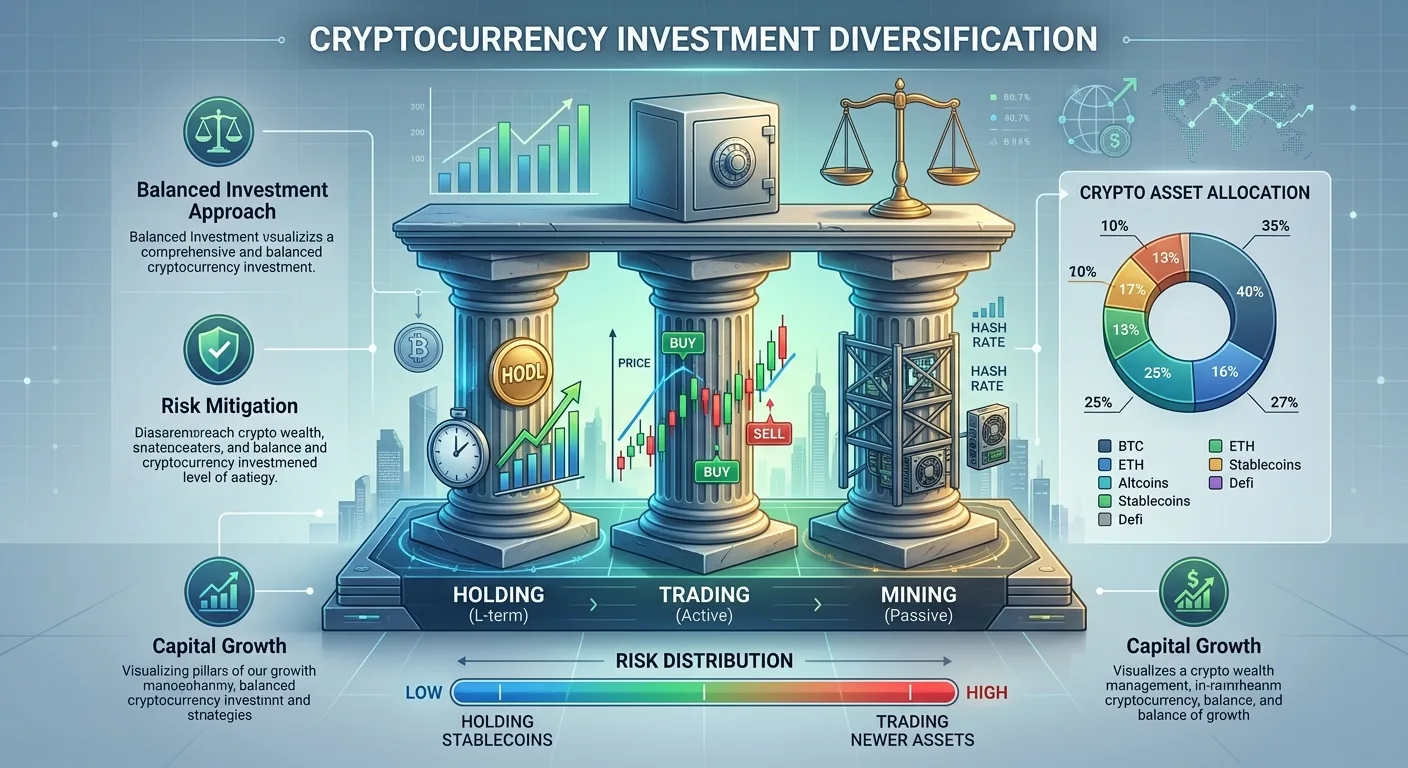
The Three Pillars of Crypto Investment
The cryptocurrency investment ecosystem can be broken down into three fundamental strategies:
1. Mining: Asset Production
Mining is the only strategy that generates cryptocurrencies rather than buying them. It represents investment in productive infrastructure.
| Feature | Description |
|---|---|
| Capital required | High (equipment, facilities) |
| Cash flow | Monthly/continuous |
| Main risk | Technological obsolescence, energy cost |
| Unique advantage | BTC accumulation without relying on available capital |
2. Trading: Alpha Capture
Trading aims to benefit from market volatility through directional positions or market-making strategies.
| Feature | Description |
|---|---|
| Capital required | Medium-high (instantly liquid) |
| Cash flow | Variable, potentially daily |
| Main risk | Capital loss, liquidation |
| Unique advantage | Returns in any market direction |
3. Holding: Long-Term Exposure
Holding (HODLing) is the simple accumulation strategy, trusting in long-term appreciation.
| Feature | Description |
|---|---|
| Capital required | Any amount (divisible) |
| Cash flow | None (capital appreciation only) |
| Main risk | Prolonged drawdowns |
| Unique advantage | Simplicity, minimal management required |
Building the Optimal Portfolio
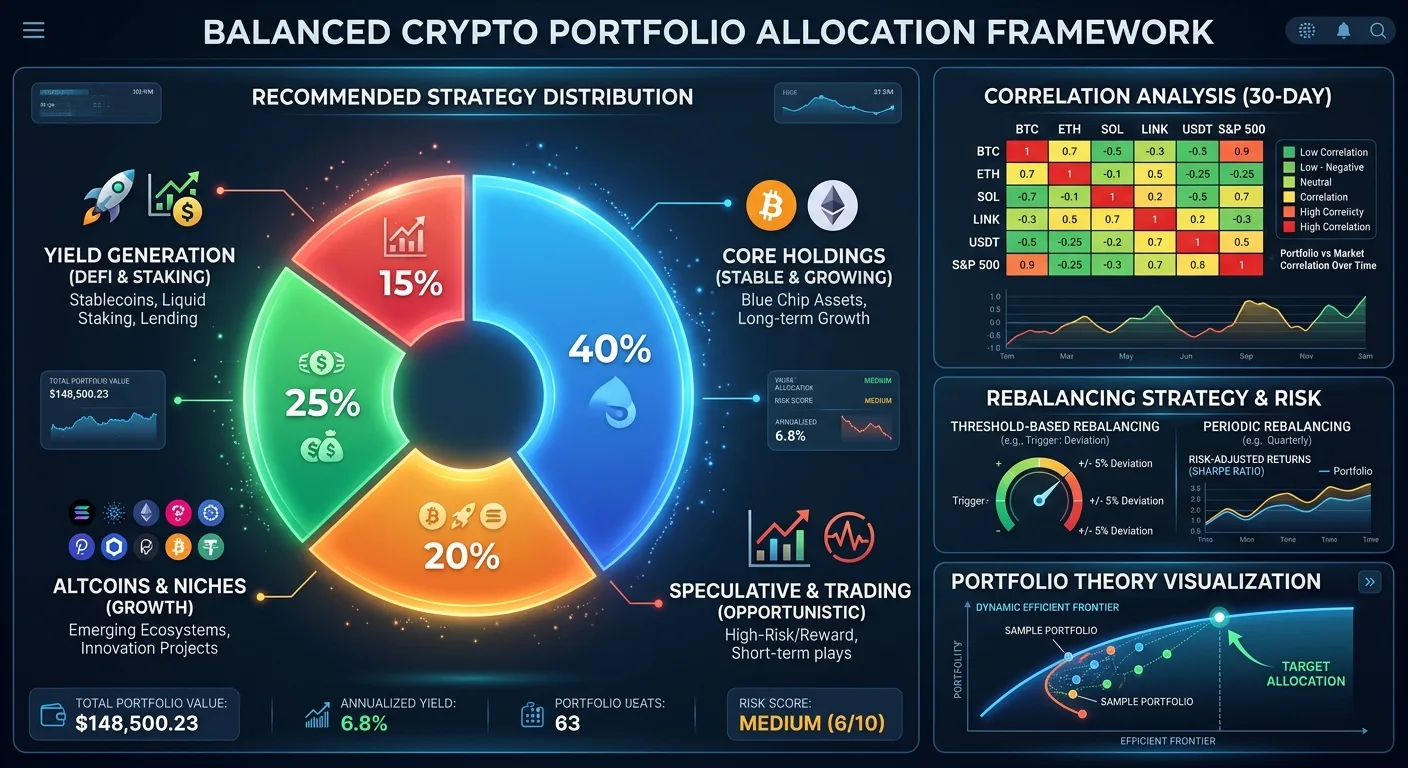
Strategic Allocation by Risk Profile
| Profile | Mining | Trading | Holding | Horizon |
|---|---|---|---|---|
| Conservative | 40% | 10% | 50% | 5+ years |
| Moderate | 35% | 20% | 45% | 3–5 years |
| Aggressive | 30% | 35% | 35% | 1–3 years |
| Speculative | 20% | 50% | 30% | <1 year |
Example: $100,000 Portfolio (Moderate Profile)
| Component | Amount | Instrument/Assets |
|---|---|---|
| Mining | $35,000 | 8x Antminer S21 in hosting |
| Trading | $20,000 | Exchange account, bots |
| BTC Holding | $30,000 | Cold wallet, continuous DCA |
| Altcoin Holding | $15,000 | ETH, SOL, L2 tokens |
Synergies Between Strategies
The true value of diversification lies not in the sum of the parts, but in the synergies created:
Synergy 1: Mining → Holding
Mining generates BTC cash flow that can be:
- Sold to cover operating costs (pay yourself first)
- Retained for accumulation (stacking sats)
- Reinvested in more hashrate (compounding)
Optimal strategy: Sell 60% for costs, retain 40% for holding.
Synergy 2: Trading → Mining
Trading profits can accelerate mining expansion:
- Purchase of additional units
- Upgrade to more efficient generations
- Financing of operating costs in bear markets
Synergy 3: Holding → Trading
Long-term holding provides:
- Collateral for leveraged trading
- Reserve of value for opportunities
- Reduced performance pressure in trading
Implementation Strategies
Strategy A: The Circular Flow
Mining → BTC Generated
    ├── 50% → Sale (operating costs + profit)
    │           └── Fiat → Buy more ASICs
    └── 50% → Holding + Trading collateral
                ├── 70% Cold storage
                └── 30% Strategic trading
Suitable for: Established mining operations with positive cash flow
Strategy B: Diversification by Market Phase
| Market Phase | Primary Action | Secondary Action |
|---|---|---|
| Early bull | Expand mining | Reduce trading |
| Late bull | Sell holding | Maximize trading |
| Early bear | Reduce mining | Accumulate holding |
| Deep bear | Buy cheap equipment | Increase DCA |
Strategy C: Temporal Diversification (DCA)
Spread entries over time to reduce timing risk:
| Week | Action | Approx. Amount |
|---|---|---|
| 1–4 | Initial mining setup | 30% capital |
| 5–12 | DCA into BTC holding | 20% capital |
| 13–24 | Progressive accumulation | 30% capital |
| 25+ | Trading with profits | 20% capital |
Risk Management in a Crypto Portfolio
Risks by Strategy and Mitigations
| Risk | Affected Strategy | Mitigation |
|---|---|---|
| BTC price drop | All | Stop losses, hedges |
| Difficulty increase | Mining | Continuous equipment upgrades |
| Technical failure | Mining | Insurance, redundancy |
| Liquidation | Trading | Never more than 2x leverage |
| Hacking | All | Cold wallets, 2FA, multisig |
| Regulation | All | Geographic diversification |
Portfolio Rebalancing
Review and rebalance quarterly:
| Rebalancing Signal | Action |
|---|---|
| Mining >50% of portfolio | Sell mined BTC, redistribute |
| Trading >30% of portfolio | Withdraw profits to holding |
| BTC Holding >60% of portfolio | Diversify to other assets |
| Any component <10% | Increase position or eliminate |
Expected Returns Comparison
| Strategy | Expected Annual Return | Volatility | Effort |
|---|---|---|---|
| BTC Holding Only | 30–50% | Very High | Minimal |
| Mining Only | 20–40% | High | High |
| Trading Only | -100% to +200% | Extreme | Very High |
| Diversified Portfolio | 25–45% | Medium-High | Medium |
Historical returns do not guarantee future results
Frequently Asked Questions about Diversification
What is the ideal ratio between mining and holding?
It depends on your profile and resources. As a general rule, mining should not exceed 40–50% of the portfolio due to concentrated operational risk. A split of 35% mining / 45% holding / 20% trading works well for most people.
Should I trade if I have no experience?
Trading is the highest-risk strategy and requires specialized knowledge. If you are a beginner, allocate a maximum of 10% to trading or use automated bots with conservative strategies (market-making, arbitrage). Prioritize holding and mining until you gain experience.
Is it better to focus only on BTC or diversify into altcoins?
For conservatives, 80%+ in BTC. For moderates, 60% BTC / 30% ETH / 10% high-conviction altcoins. For aggressive investors, a maximum of 50% BTC. Mining is generally only profitable with SHA-256 (BTC/BCH), while holding allows diversification into other protocols.
How do I rebalance when one strategy “explodes”?
If trading generates 3x in a bull run, don’t get carried away. Withdraw the principal + 50% of profits to holding, continue trading with the rest. The same applies to mining: if BTC rises 5x, consider selling part of the flow to reduce concentration.
What percentage of my total savings should be in crypto?
The conservative rule: maximum 5–10% of total net worth in crypto. Moderate: 10–20%. Aggressive: 20–30%. Never more than you can afford to lose entirely, regardless of how “safe” the market seems.
Conclusion: Diversification as a Competitive Advantage
Diversifying cryptocurrency investments is not just a risk management technique; it is a competitive advantage in a market where most participants are overexposed to a single strategy. The combination of cash flow (mining), capital appreciation (holding), and alpha capture (trading) creates a resilient portfolio that can thrive in any market condition.
The mature crypto investor understands that it is not about choosing one strategy, but about orchestrating multiple strategies that reinforce each other. Time and discipline will do the rest.
Need help designing your crypto diversification strategy? At Andes Solar Hash we advise investors in building integrated portfolios that combine professional mining with optimized holding strategies. Schedule an investment consultation and build a portfolio designed to last.
References and Sources
- Modern Portfolio Theory - Markowitz
- Bitcoin Mining Network Data
- Glassnode On-Chain Analytics
- CryptoQuant Market Data
- Messari Crypto Research
Last updated: March 22, 2026