Electricity Cost for Mining: Chile vs the World [2026]
Electricity cost for mining represents the most significant operational expense in any Bitcoin operation, typically between 60% and 80% of total costs. In a post-halving context where rewards were cut in half, optimizing this factor becomes critical for miners’ survival and profitability. Chile, with its diversified energy matrix and competitive rates, emerges as an attractive jurisdiction for both local and international miners.
This in-depth analysis compares Chilean electricity rates against the main global mining regions, examines the variables that affect your bill, and proposes concrete strategies for reducing the cost per kWh in your operation.
Why Does Electricity Define Mining Profitability?
Bitcoin mining is fundamentally a competition for cheap energy. Modern ASICs like the Antminer S21 or the Whatsminer M60S consume between 3,500W and 3,600W, operating 24/7/365. Unlike other businesses where energy cost is just one line in the P&L, in mining it is the primary determinant of break-even.
Monthly Electricity Cost Formula
Monthly Cost = (Power kW × Hours × kWh Rate) + Fixed ChargesFor a 3,500W (3.5 kW) ASIC operating in Chile at an average residential rate:
- Consumption: 3.5 kW × 720 hours = 2,520 kWh/month
- Cost: 2,520 kWh × $140 CLP (Chilean pesos) = $352,800 CLP/month (~$380 USD)
- Annual cost: ~$4,560 USD per machine
Chile vs the World: Electricity Rate Comparison
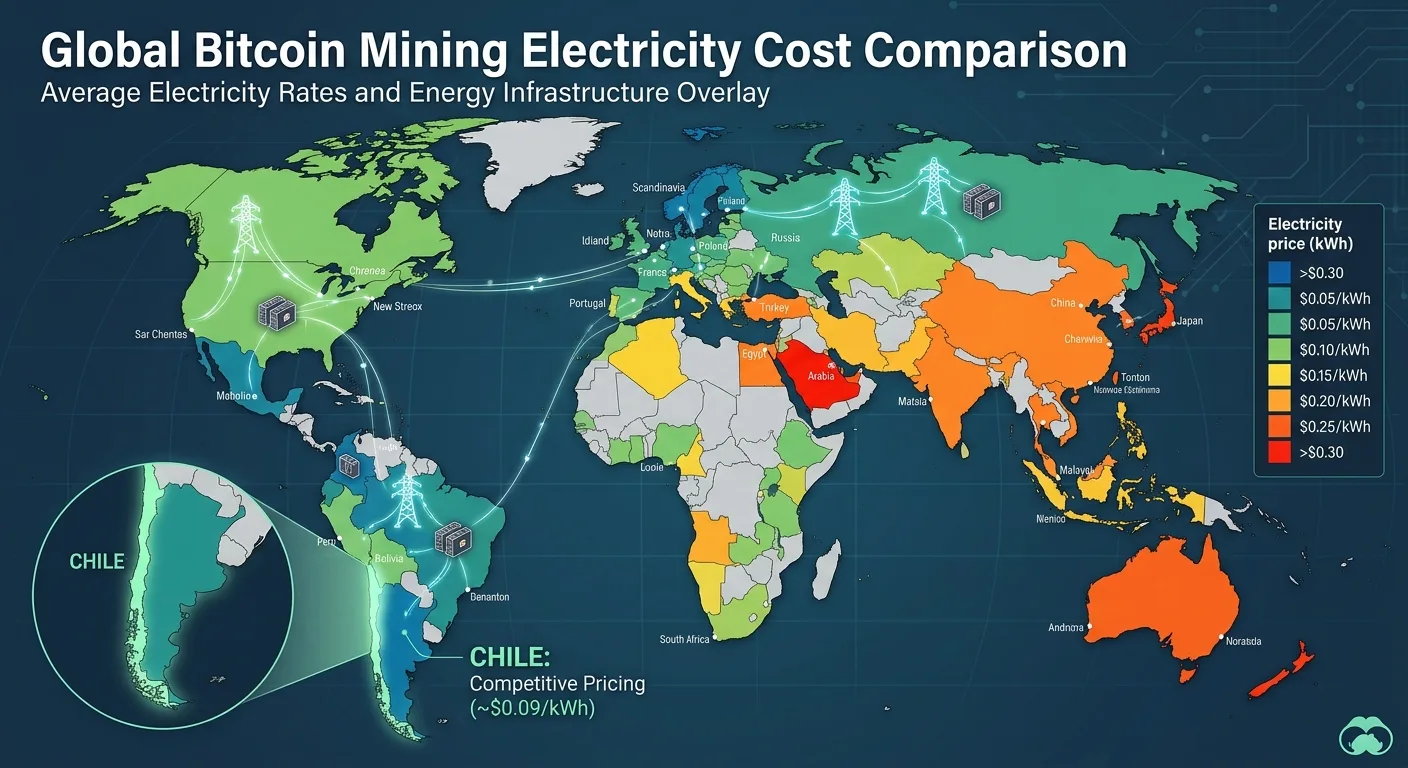
Electricity costs vary dramatically depending on region, local regulation, and generation source. The following table presents average rates for industrial/mining consumption in major jurisdictions:
Global Ranking of Costs per kWh (USD)
| Country/Region | Industrial Rate | Residential Rate | Competitiveness Ranking |
|---|---|---|---|
| Kazakhstan | $0.020–$0.030 | $0.040 | Very High |
| Texas (USA) | $0.045–$0.065 | $0.120 | Very High |
| Iceland | $0.040–$0.050 | $0.100 | Very High |
| Norway | $0.035–$0.055 | $0.120 | Very High |
| Paraguay | $0.030–$0.040 | $0.060 | Very High |
| Chile (Free Trade Zones) | $0.070–$0.095 | $0.160 | High |
| Chile (Industrial) | $0.085–$0.110 | $0.160 | High |
| Argentina | $0.020–$0.080* | $0.080 | Variable |
| Brazil | $0.090–$0.130 | $0.150 | Medium |
| Colombia | $0.080–$0.120 | $0.140 | Medium |
| Peru | $0.070–$0.100 | $0.130 | High |
| Spain | $0.120–$0.180 | $0.280 | Low |
| Germany | $0.180–$0.250 | $0.350 | Very Low |
*Argentina presents high exchange rate and regulatory volatility
Detailed Analysis of Electricity Costs in Chile
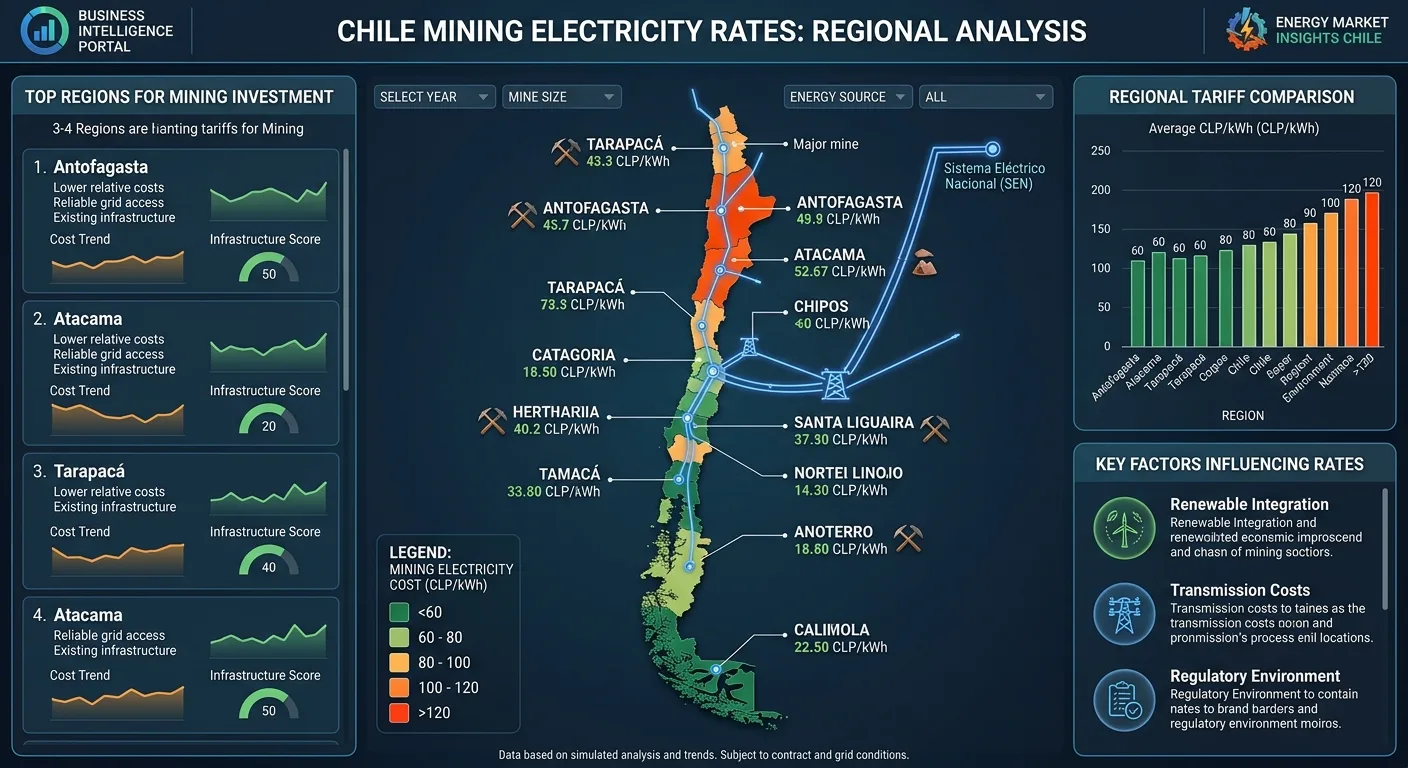
Chile operates with a National Electrical System divided into four regions: SIC (Central Interconnected System), SING (Northern Large Interconnected System), Aysén, and Magallanes. For mining, the most relevant regions are SIC and SING.
Chile’s Rate Structure (2026)
Chilean electricity costs are composed of:
| Component | % of Total | Description |
|---|---|---|
| Energy | 45–55% | Generation cost |
| Transmission | 10–15% | High-voltage transport |
| Distribution | 15–20% | Local networks |
| Access fees | 5–10% | Network access charges |
| Fixed charges | 5–10% | Commercial costs |
| Taxes | 10–15% | VAT and specific taxes |
Rates by Customer Type
| Segment | Average Rate (CLP/kWh) | Rate (USD/kWh) | Suitable for Mining? |
|---|---|---|---|
| Residential | $130–$180 | $0.14–$0.19 | Very expensive |
| Commercial | $110–$150 | $0.12–$0.16 | Not optimal |
| Industrial LV | $90–$120 | $0.10–$0.13 | Acceptable |
| Industrial HV | $75–$100 | $0.08–$0.11 | Recommended |
| Free Trade Zones | $65–$90 | $0.07–$0.10 | Optimal |
| Solar Surplus | $40–$70 | $0.04–$0.08 | Ideal |
Impact of Electricity Cost on Profitability
The difference between paying $0.15 and $0.08 per kWh can determine the complete viability of a mining operation. Let’s analyze the impact with real data:
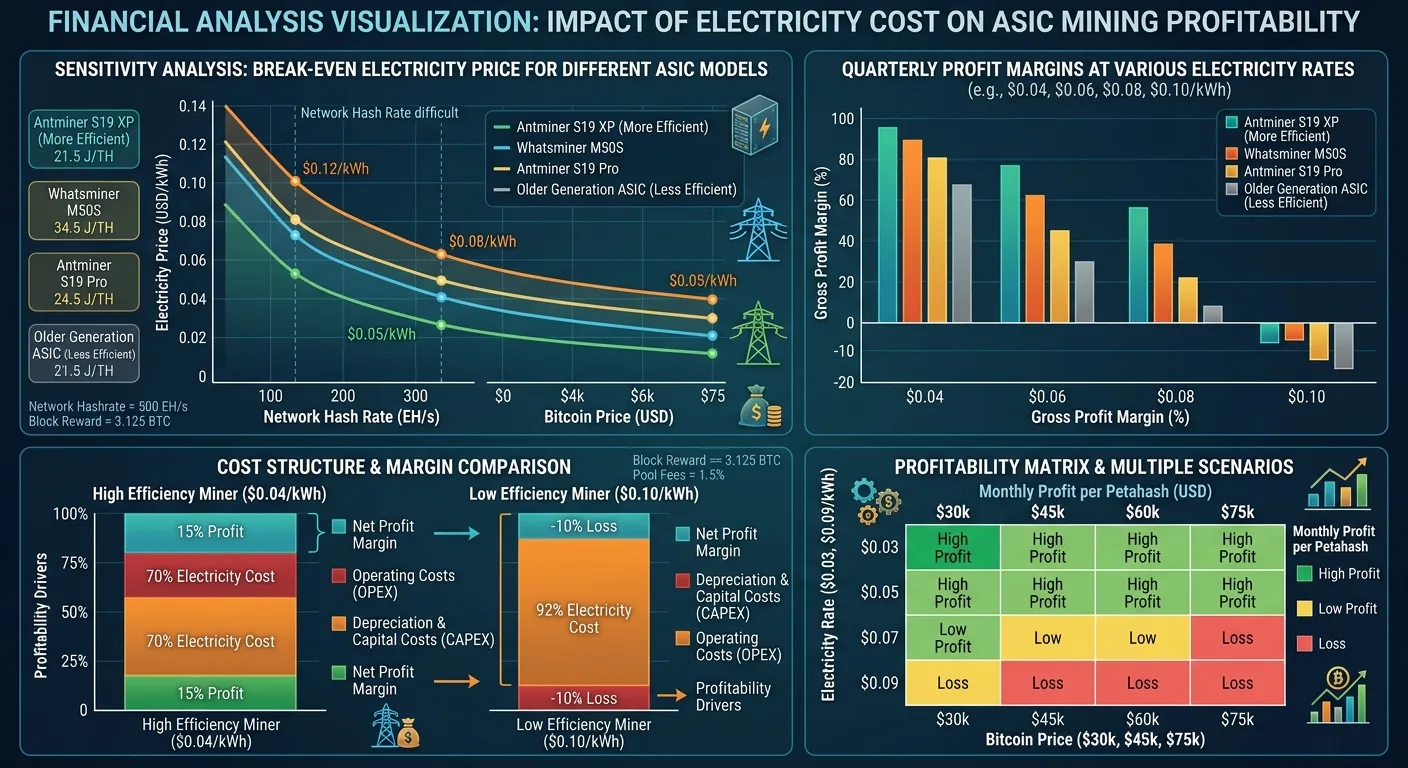
Case Study: Antminer S21 (200 TH/s)
Parameters: Hashrate 200 TH/s, power 3,500W, current difficulty, BTC price $67,000 USD.
| Rate per kWh | Monthly Cost | BTC Mined/Month | Monthly Profit | ROI (days) |
|---|---|---|---|---|
| $0.04 (Paraguay) | $100 | 0.0018 BTC | $820 | 180 |
| $0.07 (Chile FTZ) | $176 | 0.0018 BTC | $744 | 200 |
| $0.10 (Chile Ind.) | $252 | 0.0018 BTC | $668 | 220 |
| $0.14 (Chile Res.) | $353 | 0.0018 BTC | $567 | 260 |
| $0.18 (Spain) | $453 | 0.0018 BTC | $467 | 315 |
| $0.25 (Germany) | $630 | 0.0018 BTC | $290 | 510 |
Analysis conclusion: A miner in Germany needs almost 3 times longer to recover their investment compared to one in Chile. At low BTC prices, the German miner would operate at a loss while the Chilean miner maintains profitability.
Strategies for Reducing Your Electricity Cost
1. Access Industrial Rates
If you operate more than 10 ASICs, establish a company and apply for high-voltage supply. The investment in transformers pays off quickly.
2. Location in Free Trade Zones
The Free Trade Zones of Iquique (ZOFRI) and Punta Arenas offer tax exemptions and preferential electricity rates.
3. Power Purchase Agreements (PPA)
For medium-sized operations (100+ kW), negotiate directly with solar or wind generators. Rates of $0.04–$0.06 are achievable.
4. Self-Generation with Solar
Install solar panels to cover part of your consumption. The LCOE (levelized cost of energy) of solar in Chile is $0.025–$0.04 per kWh.
5. Demand Response (DR)
Some distributors pay to reduce consumption during peak hours. ASICs can be paused for 1–2 hours daily with minimal impact.
Frequently Asked Questions about Electricity Costs
What is the average electricity rate for mining in Chile?
For professional mining with industrial access, rates range between $70 and $110 CLP per kWh ($0.075–$0.12 USD), depending on the region, monthly consumption, and type of supply. In free trade zones or with self-generation, $50–$70 CLP/kWh is achievable.
Why do rates vary so much between regions of Chile?
Differences are explained by: (1) Distance from generation centers, (2) Transmission costs, (3) Local energy mix (solar in the north is cheaper), and (4) Regional subsidies in extreme zones.
Is it better to have my own solar generation or buy from the grid?
For stable operations (>2 year horizon), self-generation offers lower cost ($0.03–$0.05/kWh) and protection against rate increases. It requires an initial investment but the typical payback is 3–5 years.
How do I calculate my real cost per kWh including all charges?
Divide your total bill (including taxes and fixed charges) by the kWh consumed. Many miners are surprised to discover they pay 20–30% more than the nominal rate by not accounting for all components.
What happens to electricity costs during a halving?
Post-halving, miners with costs >$0.10/kWh fall outside the profitability curve and must shut down. Only these survive: (a) efficient miners (new equipment), (b) miners with cheap energy (<$0.08/kWh), or (c) miners with capital reserves.
Conclusion: Chile, a Competitive Jurisdiction
Electricity costs for mining in Chile position the country as an attractive option in the Latin American landscape, surpassed only by regions with hydroelectric surpluses like Paraguay or certain regions of Argentina with subsidies. The combination of institutional stability, reliable infrastructure, and competitive industrial rates makes Chile a preferred destination for serious miners.
To maximize profitability, prioritize access to industrial rates or free trade zones, consider self-generation solar, and keep your equipment updated to the latest efficient ASIC generations.
Want to reduce your electricity cost immediately? At Andes Solar Hash we connect you with industrial rates from $75 CLP/kWh at our facilities. Request a free energy audit and discover how much you can save by migrating your operation.
References and Sources
- National Energy Commission - Regulated Rates
- Cambridge Bitcoin Electricity Consumption Index
- Global Petrol Prices - Electricity
- Bitcoin Mining Council Q4 2023 Report
- Ministry of Energy Chile - Energy Matrix
Last updated: March 22, 2026