Bitmain and Antminer: History, Evolution, and Best Models
The history of Bitmain and Antminer is inextricably tied to the history of Bitcoin mining itself. From its humble beginnings in 2013 to becoming the undisputed giant of the mining hardware industry, Bitmain has repeatedly revolutionized the landscape with innovations that have set standards and shaped the decentralization of the Bitcoin network. This historical journey takes you from the first Antminer to the impressive latest-generation equipment of today.
The Origins of Bitmain
Founding and Early Years (2013–2014)
Bitmain Technologies Ltd. was founded in 2013 in Beijing, China, by Micree Zhan (the technical genius behind the chips) and Jihan Wu (the business strategist). Their mission was clear: create specialized hardware for cryptocurrency mining that would far surpass the efficiency of GPUs.
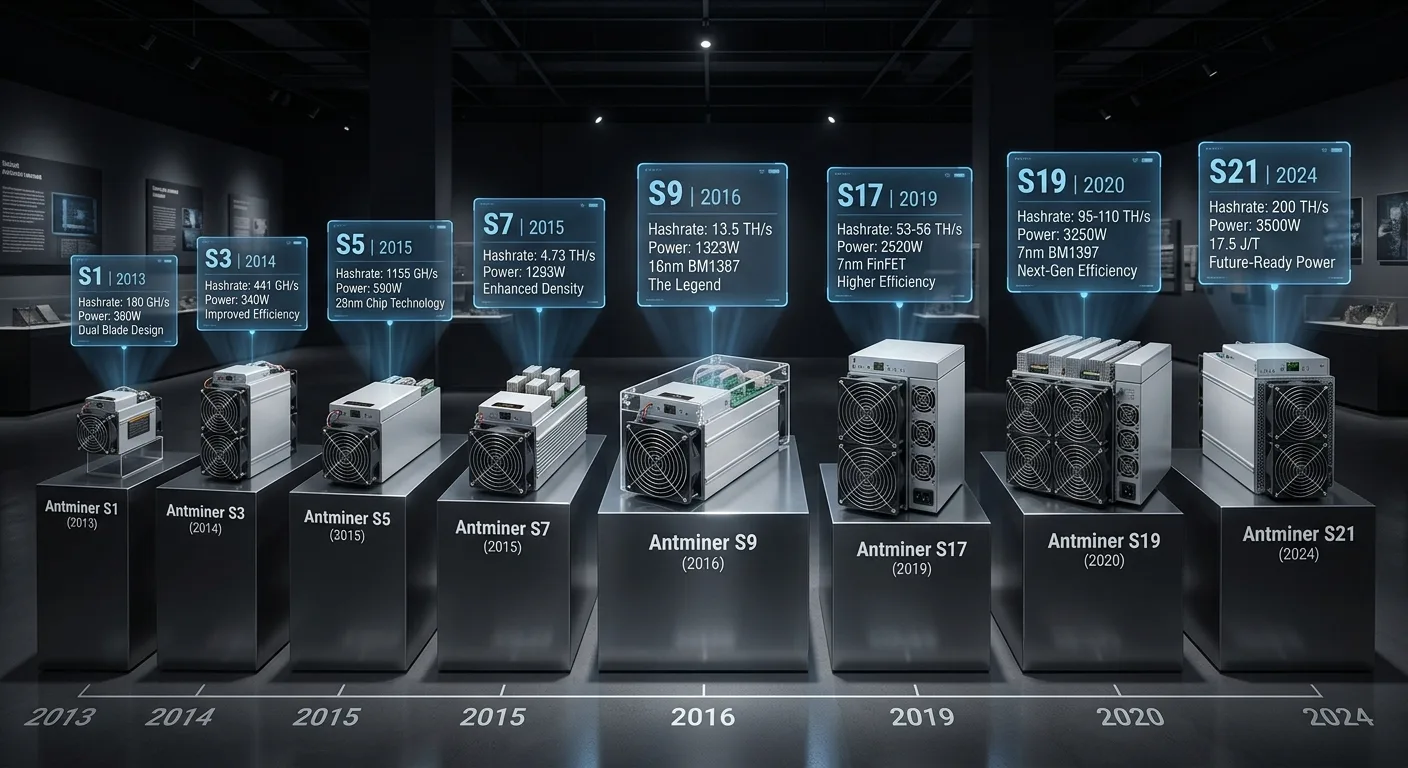
The first product, the Antminer S1, launched in December 2013, marked the beginning of a new era. With 180 GH/s and 360W power consumption, it was revolutionary for its time, though it seems insignificant compared to modern equipment.
| Model | Year | Hashrate | Power | Efficiency |
|---|---|---|---|---|
| Antminer S1 | 2013 | 180 GH/s | 360W | 2000 J/GH |
| Antminer S2 | 2014 | 1 TH/s | 1,100W | 1100 J/GH |
| Antminer S3 | 2014 | 441 GH/s | 340W | 771 J/GH |
| Antminer S4 | 2014 | 2 TH/s | 1,400W | 700 J/GH |
| Antminer S5 | 2014 | 1.15 TH/s | 590W | 513 J/GH |
The Era of SHA-256 Dominance (2015–2017)
The S7 and S9 Revolution
The Antminer S7 (2015) and especially the Antminer S9 (2016) cemented Bitmain’s dominance in the market. The S9, with its 16nm manufacturing process, was an absolute game-changer.
Antminer S9: The Legendary Unit
| Specification | Value |
|---|---|
| Hashrate | 13.5 TH/s |
| Power | 1,323W |
| Efficiency | 98 J/TH |
| Process | 16nm |
| Operational life | 2016–2022 (6 years) |
The S9 remained profitable for nearly 6 years, something unthinkable in the technology industry. Many S9 units still operate in regions with extremely cheap electricity.
| Model | Year | Hashrate | Efficiency | Process |
|---|---|---|---|---|
| S7 | 2015 | 4.73 TH/s | 250 J/TH | 28nm |
| S9 | 2016 | 13.5 TH/s | 98 J/TH | 16nm |
| T9 | 2016 | 12.5 TH/s | 125 J/TH | 16nm |
| R4 | 2016 | 8.7 TH/s | 126 J/TH | 16nm |
| S9i | 2018 | 14 TH/s | 93 J/TH | 16nm |
Innovation and Competition (2018–2020)
The 7nm War
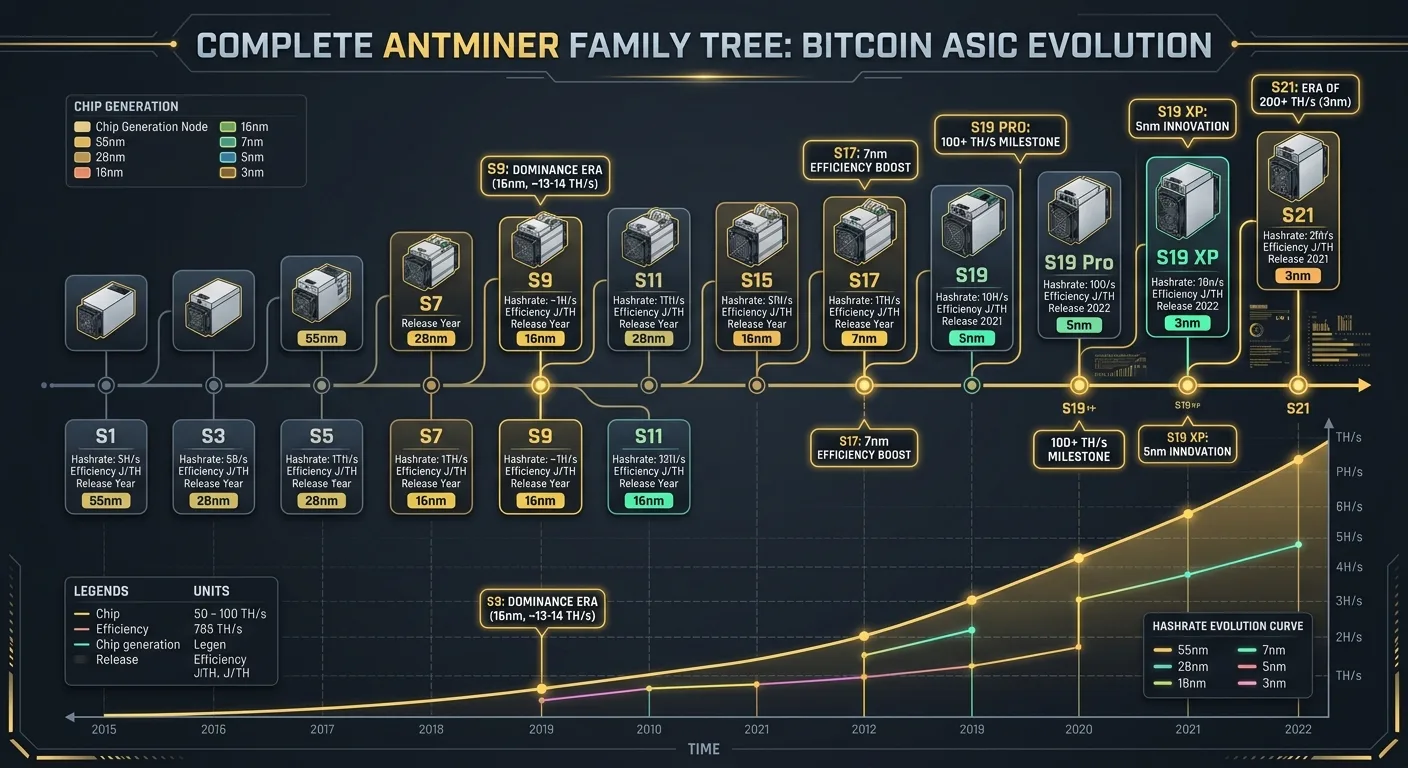
With the arrival of competitors like MicroBT (Whatsminer) and Canaan (AvalonMiner), Bitmain responded with the S17 series and subsequently the S19, using 7nm manufacturing processes.
Evolution of the S19 Series
| Model | Year | Hashrate | Efficiency | Process |
|---|---|---|---|---|
| S17 | 2019 | 56 TH/s | 45 J/TH | 7nm |
| S17 Pro | 2019 | 62 TH/s | 39.5 J/TH | 7nm |
| S19 | 2020 | 95 TH/s | 34.2 J/TH | 7nm |
| S19 Pro | 2020 | 110 TH/s | 29.5 J/TH | 7nm |
| S19j Pro | 2021 | 104 TH/s | 29.5 J/TH | 5nm |
| S19 XP | 2022 | 141 TH/s | 21.5 J/TH | 5nm |
The S19 series was the industry standard during the 2020–2023 era, with the S19 XP being particularly notable for achieving sub-25 J/TH efficiency.
The Modern Era: S21 and Beyond (2023–2026)
Antminer S21: The New Gold Standard
Launched in November 2023, the Antminer S21 represents the leap to 3nm processes, achieving the historic milestone of 15 J/TH efficiency.
| Variant | Hashrate | Power | Efficiency | Approx. Price |
|---|---|---|---|---|
| S21 (200T) | 200 TH/s | 3,500W | 17.5 J/TH | $3,500 |
| S21 (234T) | 234 TH/s | 3,510W | 15.0 J/TH | $4,200 |
| S21 Pro (335T) | 335 TH/s | 5,360W | 16.0 J/TH | $6,500 |
The Significance of Each Nanometer
The evolution of manufacturing processes has been the engine of efficiency improvement:
| Generation | Process | Best Efficiency | Year |
|---|---|---|---|
| 1st Gen | 55nm | 2000+ J/TH | 2013 |
| 2nd Gen | 28nm | 250 J/TH | 2015 |
| 3rd Gen | 16nm | 98 J/TH | 2016 |
| 4th Gen | 7nm | 39.5 J/TH | 2019 |
| 5th Gen | 5nm | 21.5 J/TH | 2022 |
| 6th Gen | 3nm | 15.0 J/TH | 2023 |
The Best Models in History
Top 5 by Historical Impact
-
Antminer S9 (2016)
- The most long-lived and successful unit in history
- Remained profitable for 6 years
- Defined the era of professional mining
-
Antminer S19 XP (2022)
- A perfect bridge between generations
- Excellent cost-benefit balance
- Mature and reliable 5nm technology
-
Antminer S21 (2023)
- Market-leading efficiency today
- First commercial unit below 20 J/TH
- The future industry standard
-
Antminer S17 Pro (2019)
- Introduced 7nm processes at scale
- Direct competitor to the Whatsminer M20S
- Marked Bitmain’s recovery post-civil war
-
Antminer S5 (2014)
- Popularized accessible home mining
- Efficient design for its era
- Large modding community
Bitmain’s Factory and Operations
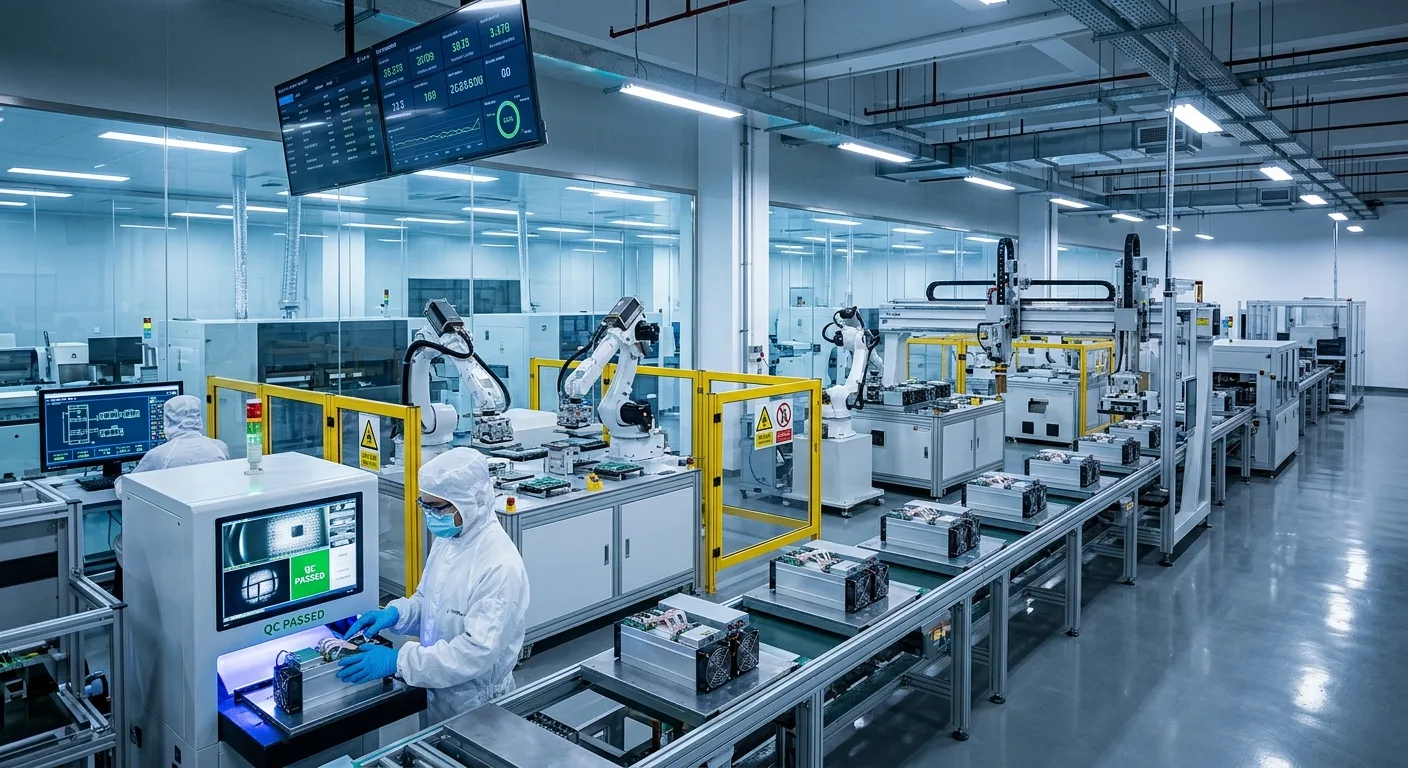
Bitmain operates multiple manufacturing and testing facilities in:
- China: Main R&D and production centers
- Mongolia: Assembly and testing factory
- Malaysia: Production expansion post-Chinese restrictions
- Kazakhstan: Proprietary data centers
The company has produced over 10 million Antminer units since 2013, controlling approximately 75% of the SHA-256 ASIC market.
Frequently Asked Questions
Why does Bitmain dominate the ASIC market?
Bitmain achieved dominance through:
- Scale advantage: Greater production capacity than competitors
- Vertical integration: Control from chip design through distribution
- Cost efficiency: Continuous optimization of manufacturing processes
- Distribution network: Global presence established since 2014
- Constant innovation: Leader in adopting new manufacturing processes
What happened with Bitmain’s “civil war” in 2019–2020?
In 2019, co-founders Micree Zhan and Jihan Wu had a dispute over control of the company that resulted in:
- Temporary division of the company
- Zhan taking operational control
- Wu founding Matrixport and leaving Bitmain
- Resolution in 2021 with Zhan buying Wu’s stake
The company has operated stably since then under Zhan’s leadership.
Are Antminers better than Whatsminers or AvalonMiners?
| Brand | Strengths | Weaknesses |
|---|---|---|
| Bitmain (Antminer) | Greater variety, better efficiency | History of controversies |
| MicroBT (Whatsminer) | Reliability, good support | Lower efficiency than top Bitmain |
| Canaan (AvalonMiner) | Innovation, design | Lower market share |
Bitmain generally leads in efficiency with its top-of-the-line models, although MicroBT offers excellent competition in the mid-range segment.
When will the next model after the S21 be released?
Based on Bitmain’s historical cycles:
- 2nm process: Probably 2025–2026
- Possible S23 or S25: Late 2025 or 2026
- Incremental S21 upgrades: “Pro” and “XP” variants in 2024–2025
Is it worth buying older models like the S9 or S17?
| Model | Recommendation | Conditions |
|---|---|---|
| S9 | Only if electricity < $0.03/kWh | For learning or very cheap regions |
| S17 | Electricity < $0.05/kWh | Very limited budget |
| S19 | Electricity < $0.10/kWh | Good option if verified used |
| S21 | Any profitable condition | Recommended investment |
Conclusion
The history of Bitmain and Antminer is a testament to technological evolution in the crypto industry. From the modest 180 GH/s of the S1 to the impressive 335 TH/s of the S21 Pro, each generation has represented significant advances in energy efficiency and computing power.
The key milestones:
- 2013: Birth with the S1
- 2016: The golden age of the S9
- 2020: Absolute dominance with the S19 series
- 2023: New frontier with the S21 and 3nm process
For current miners, the choice between historical and modern models depends on the balance between available budget and operating costs. The S21 represents the future, while models like the S19 XP offer excellent value in the present.
Interested in the living history of Bitcoin mining? At Andes Solar Hash we have availability of models from the S19 up to the most advanced S21. Our team can advise you on which Antminer generation best fits your needs.
Contact us and gain access to the best Bitmain models on the market.
References and Sources
Primary Sources
- CoinMetrics
- Cambridge Bitcoin Electricity Consumption Index
- Bitcoin Mining Council
- Bitmain Official
- ASIC Miner Value
Chilean Government Sources
Related Articles
Last updated: March 22, 2026
2025–2026 Update: New Developments
Recent Launches
During 2024–2025, Bitmain continued innovating with new S21 variants:
| Model | Launch | Hashrate | Efficiency | Features |
|---|---|---|---|---|
| S21+ | 2024 | 250 TH/s | 14.5 J/TH | Improved cooling |
| S21 XP | 2025 | 280 TH/s | 14.0 J/TH | Improved 3nm process |
| S21 Pro+ | 2025 | 350 TH/s | 15.5 J/TH | High density |
2026 Market Trends
- Consolidation of 3nm process: 3nm equipment dominates the high-efficiency market
- 2nm process in development: Bitmain announces progress toward 2nm processes for 2026–2027
- Sub-14 J/TH efficiency: The new gold standard for premium equipment
- Greater integration: More advanced controllers and improved remote monitoring